Campaign Briefs:
Restoring Stronger Water Protections (NorBE)
Learn what is the Neutral or Beneficial Effect test matters, why it matters, how it was weakened and what the Alliance is calling for.
Stop coal mines from destroying the Gardens of Stone
Overview of existing coal mines, proposed expansions and the impacts on the region.
Locals tracking waterway health
Independent community monitoring and government data showing how water quality is changing across the catchment.
Stop dirty mine water being dumped into the river
How the promised zero-discharge system works, where it has fallen short, and why it matters.
Centennial Coal's - Gardens of Stone Environmental Scorecard Jan 2025 (3.6Mb pdf)
Restoring NorBE: what needs to change
The Neutral or Beneficial Effect (NorBE) test was introduced in 1998 after Sydney’s drinking water contamination crisis. Its purpose was straightforward: development within the drinking water catchment should only proceed if it maintains or improves water quality.
In 2017, Alliance member 4nature successfully challenged the approval of Springvale Coal Mine in the NSW Supreme Court. Before final orders were made, the Coalition Government passed special legislation allowing the mine to continue operating and weakening NorBE for existing coal developments. Mine extensions and modifications can now avoid the full test, while impacts may be assessed against waterways already polluted by mining.
Labor strongly opposed these changes. Chris Minns warned they created a dangerous precedent, while then Opposition Leader Luke Foley and Penny Sharpe committed a future Labor government to restoring proper catchment protections. Labor was elected in 2023, but that promise remains unfulfilled as NSW approaches the March 2027 election.
The Gardens of Stone Alliance is calling for reforms that:
• make NorBE mandatory for all developments, expansions and modifications
• remove the special exemptions for existing coal mines
• require public authorities to meet the same standard as developers
• assess impacts against a genuine “no development” baseline, not existing pollution
• protect both local waterways and the ultimate receiving environment, including stored drinking water
• require cumulative improvement in water quality
• prevent pollution transfers labelled as “beneficial reuse” from satisfying NorBE
These changes would close known loopholes, encourage investment in pollution treatment and deliver the protections Labor promised.
Key Sites for Coal Operations in the Gardens of Stone region
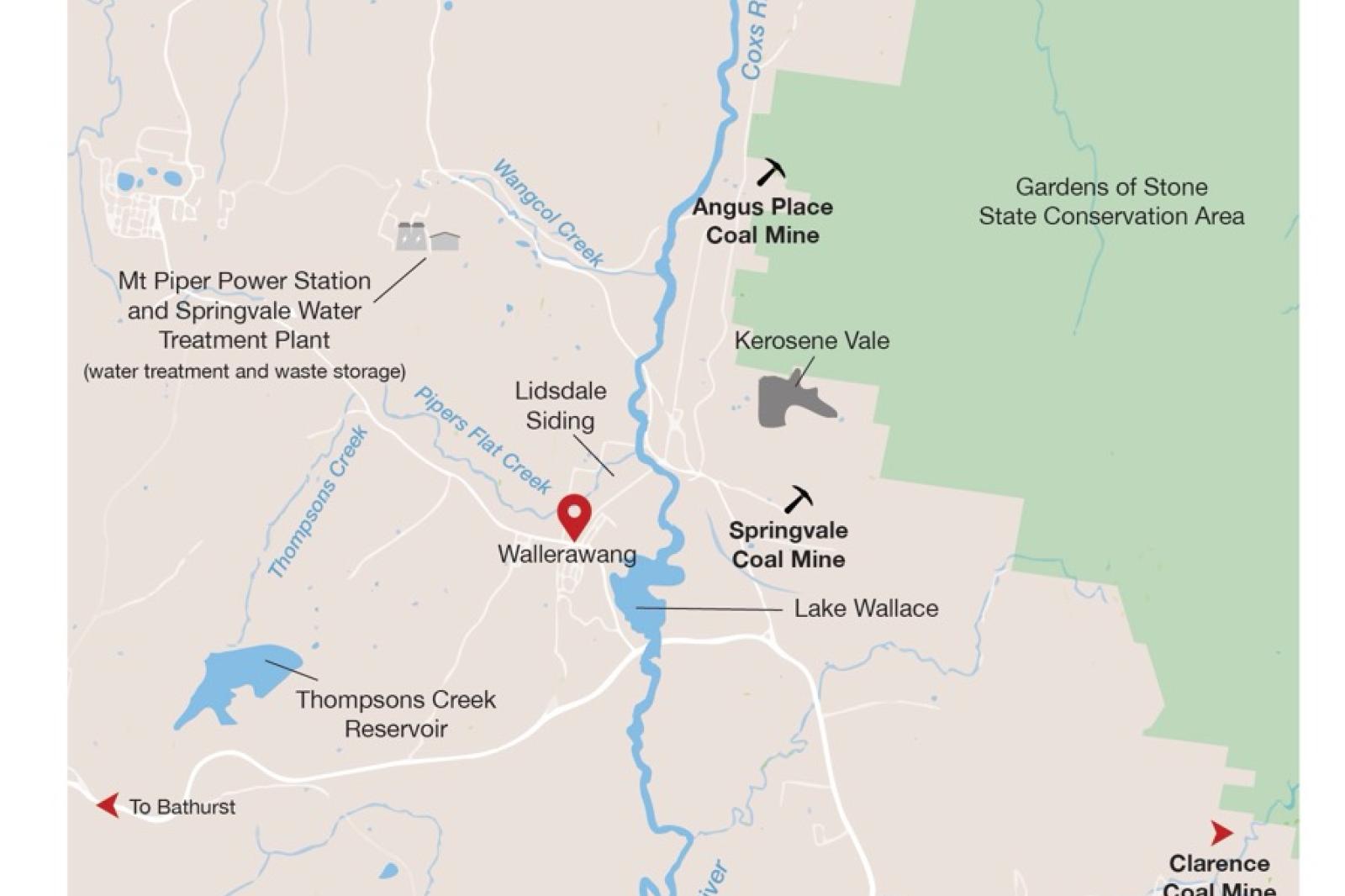
The threat to the Gardens of Stone is not limited to existing mines. Centennial Coal is advancing or foreshadowing proposals that could extend underground mining, its wastewater burden and environmental impacts well into the 2030s.
Springvale Mine remains a major supplier to Mount Piper Power Station. As reserves decline, the proposed Springvale West expansion would open new longwall areas, bringing further risks to groundwater, headwater streams, upland swamps and the volume of contaminated mine water requiring treatment or discharge.
Nearby Angus Place is not currently producing coal but continues to generate millions of litres of contaminated mine water each day. Centennial has sought to delay rehabilitation while pursuing Angus Place West, a proposed new mining area that could damage sensitive waterways and biodiversity. These proposed expansions are being presented as important to maintaining Mount Piper’s coal supply, even as the power station moves towards a lower-output role.
At Clarence Colliery, a proposed modification would extend mining from 2026 to 2031. This follows repeated pollution incidents affecting the Wollangambe River, including recent convictions and penalties for unlawful discharges.
Together, these are not minor operational changes. They could lock in another generation of mining impacts across waterways connected to the Greater Blue Mountains World Heritage Area. The Alliance is pressing government to assess cumulative effects and properly test alternatives before accepting that new mine expansions are necessary.
Community Water Monitoring
For more than two decades, volunteers associated with Alliance member Lithgow Environment Group have tested waterways across the Lithgow region. The program began because local conservationists needed an independent, long-term record of what was happening downstream of coal mine, particularly where official monitoring was difficult to access, too infrequent or not designed to capture ad hoc pollution events.
This community work complements, rather than replaces, monitoring by WaterNSW, the EPA and mining companies. The NSW Government itself has acknowledged that water-quality responsibilities and datasets are fragmented, that important monitoring gaps remain, and that information is not always collected or shared quickly enough to support effective responses. Regular local testing can identify pollution spikes, document patterns over time and provide evidence for regulators, researchers and Planners.
The results have repeatedly shown stark differences between relatively healthy waterways and sites affected by mining discharges. In May 2026, volunteers recorded electrical conductivity, a measure closely related to salinity, of 4,220 microsiemens per centimetre at Western Coal Services Licensed Discharge Point 1. This is around twelve times the guideline value of 350 for slightly disturbed ecosystems. By comparison, readings were just 39 in the upper Coxs River and 220 in the Nepean River at Penrith.
This evidence has helped keep mining pollution in public view, strengthen calls for regulatory reform and hold companies and government agencies accountable. The Alliance is now recruiting and supporting new volunteers to continue the monitoring legacy built over 21 years by local water defenders.
The failed “zero-discharge” promise
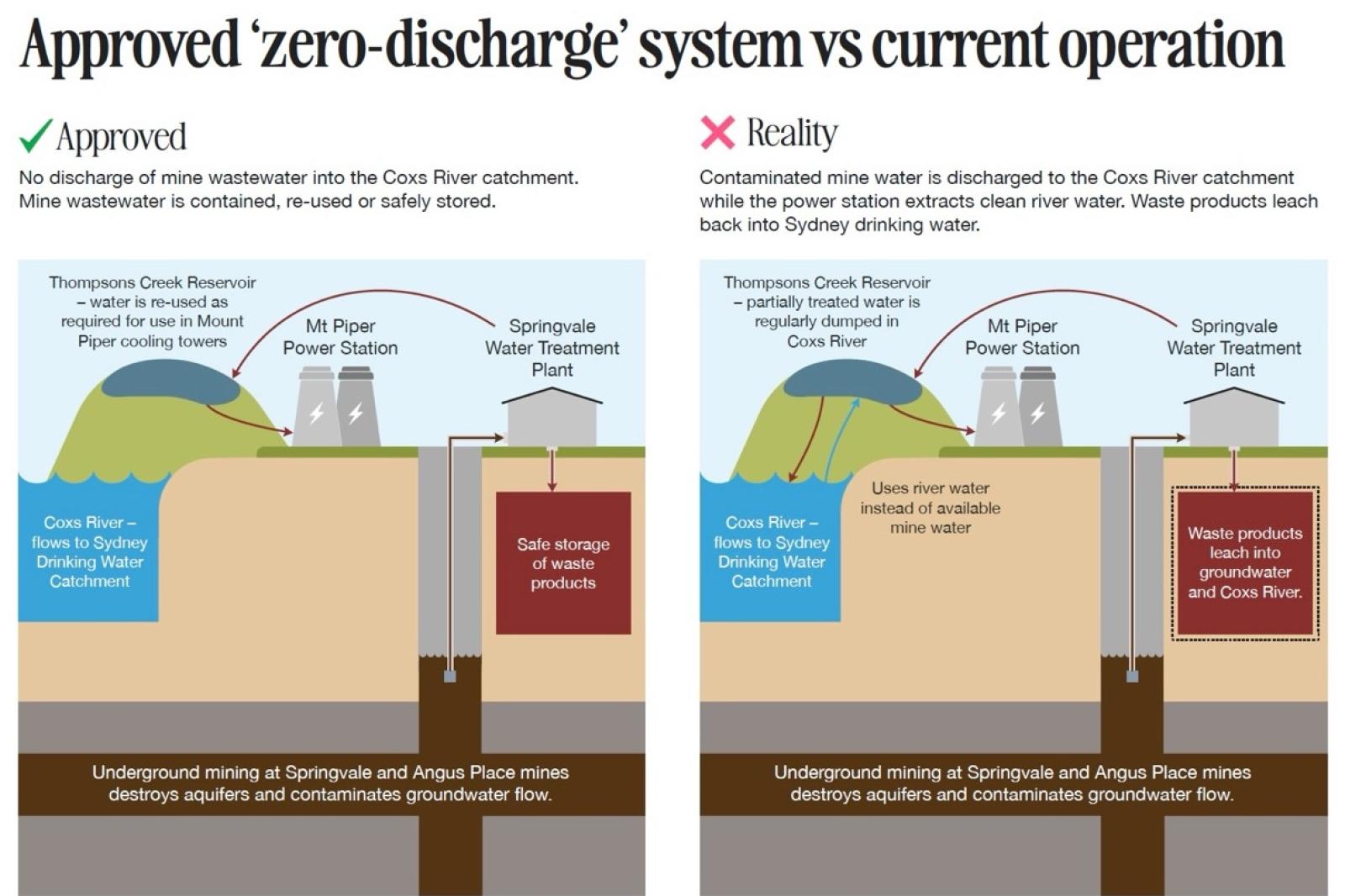
The Springvale Water Treatment Plant was built after sustained community advocacy and legal action over pollution from Springvale Coal Mine. When it began operating in 2019, the system was presented as a major environmental solution: contaminated water intercepted by the Springvale and Angus Place mines would be treated, reused at Mount Piper Power Station and kept out of the Coxs River catchment. The power station would also reduce its reliance on cleaner river water.
The plant has improved the quality of some mine water, but treatment alone cannot solve the problem. Springvale and Angus Place together generate around 42 million litres of mine water each day. The system must be able to treat that water, find a continuing use for the treated product and safely manage the concentrated salt and contaminant waste left behind. As Mount Piper operates less frequently, its capacity to consume treated mine water also falls.
Excess water is instead directed through Thompsons Creek Reservoir. EnergyAustralia has acknowledged releases of up to 20 million litres a day from the reservoir. This means mine-affected water continues to enter Thompsons Creek and flow towards the Coxs River, despite the original promise of no routine dirty-water discharge. Meanwhile, treatment brine mixed with power-station ash has created further risks where waste was placed in poorly lined repositories.
The issue is therefore not simply whether a treatment plant exists, but whether the entire water-management system can contain and properly treat the volume of pollution mining creates. The NSW Government has now directed Centennial Coal and EnergyAustralia to pursue all feasible solutions and resolve the problem.